
Why Over 300 Million People Worldwide Live With Major Depressive Disorder


Approximately 300 million people worldwide live with major depressive disorder (MDD), making it one of the leading contributors to reduced quality of life globally. Despite the availability of conventional antidepressant treatments, only around 30–40% of patients achieve a full response, highlighting the need for continued exploration into complementary and alternative approaches.
Traditional antidepressants generally work by influencing monoamine neurotransmitters, yet some individuals experience delayed onset of action, limited effectiveness, or unwanted side effects. Researchers are therefore increasingly investigating multi-target natural compounds that may influence several biological pathways associated with emotional wellbeing and stress resilience.
Why Interest in Herbal Medicines Is Increasing
Many herbal substances have demonstrated potential mood-supporting effects in both preclinical and clinical studies. Some appear to act through pathways similar to standard antidepressants, while others may influence multiple neurobiological systems simultaneously.
The World Health Organization (WHO) has encouraged evidence-based investigation into traditional and complementary medicines to better understand their safety, effectiveness and potential role in healthcare.
In many resource-limited settings, herbal medicines remain an important component of primary healthcare, despite a need for stronger scientific evidence supporting their use.
Traditional Use of Sceletium tortuosum
Within this growing field of research, interest has increasingly focused on Sceletium tortuosum (ST) — an indigenous South African plant with a long history of traditional use among the Khoisan people.
For generations, Sceletium tortuosum has been traditionally used as a:
Mood support herb
Relaxation aid
Traditional anxiolytic supportAppetite suppressant
Aid during periods of stress
Support for general wellbeing
Its historical use has contributed to modern scientific interest in understanding how its active compounds may influence neurological pathways.
The Unique Alkaloid Profile of Sceletium tortuosum
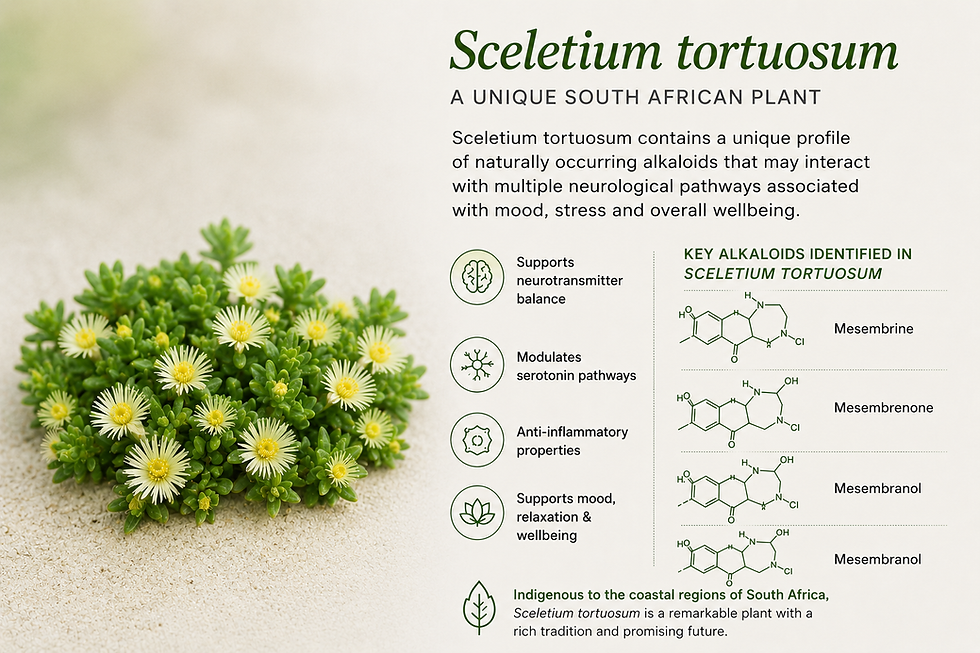
Sceletium tortuosum contains several naturally occurring alkaloids, including:
Mesembrine
Mesembrenone
Mesembrenol
Mesembranol
Research suggests these compounds may have subtly different neuro-pharmacological actions, potentially influencing multiple systems associated with mood regulation and emotional balance.
Studies have investigated possible mechanisms including:
✓ Modulation of serotonin transporter (SERT) activity✓ Inhibition of phosphodiesterase 4 (PDE4)✓ Effects on monoamine pathways✓ Influence on dopamine and noradrenaline transport systems✓ Potential anti-inflammatory actions✓ Effects involving vesicular monoamine transporter pathways (VMAT-2)
This multi-modal activity is one reason why Sceletium continues to attract scientific interest, as emotional wellbeing is influenced by numerous interconnected biological processes rather than a single pathway alone.
Emerging Research and Safety ProfileCurrent evidence suggests Sceletium tortuosum may demonstrate a relatively favourable side effect profile compared with some conventional interventions, although further large-scale human studies remain necessary.
Researchers continue to investigate whether Sceletium’s multi-target actions may contribute to supporting emotional wellbeing, stress resilience and cognitive function.
However, scientific exploration remains ongoing, and more evidence is required to fully understand long-term effects, optimal use and clinical applications.
Looking Ahead
The growing scientific interest surrounding Sceletium tortuosum reflects a broader movement toward investigating traditional botanical medicines through modern evidence-based research.
Its long history of traditional use, combined with emerging studies into its complex alkaloid profile and neurological mechanisms, suggests that Sceletium tortuosum may continue to be an important area of future research in emotional wellbeing and stress-related conditions.
As research evolves, understanding how traditional plants and modern science intersect may offer new perspectives on supporting overall wellbeing.
Important Note
This article is intended for educational purposes only. Sceletium tortuosum and products containing Sceletium are not intended to diagnose, treat, cure or prevent depression or any medical condition. Individuals experiencing symptoms of depression or other mental health concerns should seek guidance from a qualified healthcare professional.


Comments